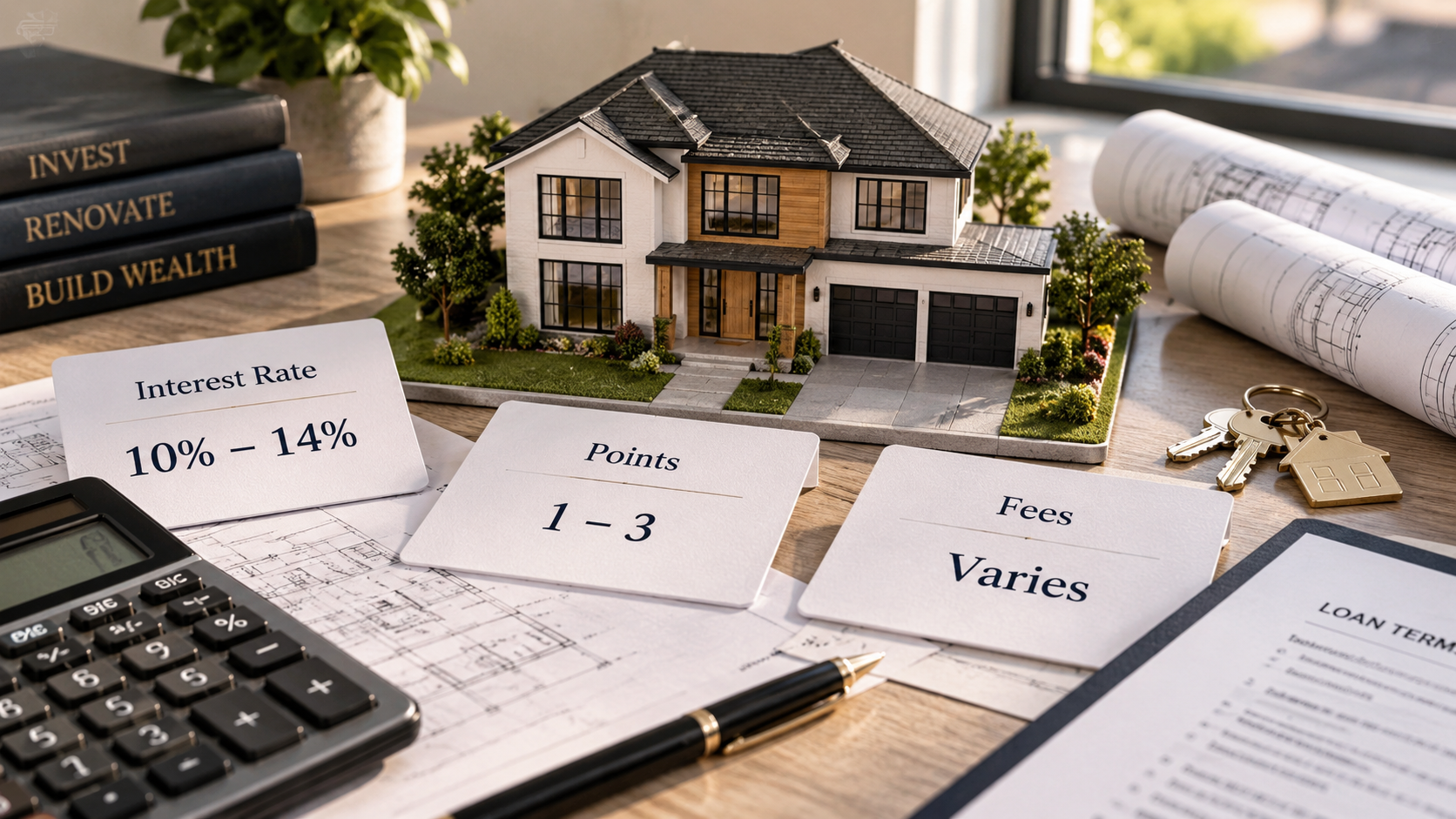
Hard money loan rates in 2026 generally fall around 9.5% to 13% for many first-position loans, although pricing can be lower or higher depending on the lender, property, leverage, borrower experience, and deal structure.
Unlike conventional mortgages, however, the interest rate alone does not tell you what a hard money loan will actually cost. Points, lender fees, closing expenses, and how long you keep the loan can all have a major impact on the final price.
That makes comparing hard money loans less about finding the lowest advertised rate and more about calculating the total cost of capital for your particular deal. Below, we break down current hard money rates, points and fees, loan-type differences, and a real-dollar example showing how the cost changes depending on your holding period.
Key Takeaways
- Current 2026 market data suggests many first-position hard money loans fall around 9.5%–13% interest, although there is no authoritative nationwide average.
- Origination charges commonly add roughly 1.5–3 points to competitively priced investor loans, while some programs and higher-risk transactions can cost more.
- Your LTV/LTC, property, project economics, experience, exit strategy, loan size, and other risk factors can influence the rate a lender offers.
- Points matter particularly on short-term loans because they are generally charged on the loan amount regardless of whether you hold the loan for six months or twelve.
- The cheapest hard money loan is not necessarily the loan with the lowest interest rate.
What Are Hard Money Loan Rates in 2026?
Current hard money loan rates generally run about 9.5%–13% for many first-position loans in 2026, with approximately 1.5–3 origination points commonly reported in current market guides. These numbers represent market ranges rather than a universal average because hard money lending does not have a nationwide rate survey comparable to the conventional mortgage market.
Individual lenders may advertise starting rates below these levels, particularly for experienced investors and lower-leverage transactions.
| Pricing Component | Typical 2026 Market Range | What It Means |
| Interest rate | Roughly 9.5%–13% for many first-position loans | Annualized interest charged on the outstanding balance |
| Origination points | Roughly 1.5–3 points on many competitive programs | Upfront lender charge based on loan amount |
| Loan term | Commonly 6–24 months, depending on program | Period before the loan must be repaid or refinanced |
| LTV/LTC | Varies widely; often roughly 65%–75% LTV on hard money/bridge programs | Determines how much of the property’s value or project cost the lender finances |
| Other costs | Deal-specific | May include valuation, title, legal, processing, draw, or extension costs |
The wider market is important here. A 2026 comparison of investor lenders, for example, found published fix-and-flip starting rates ranging from 7.25%+ to 10.49%+, depending on the lender. Those are starting rates rather than market averages, and the actual quote can differ substantially once leverage, property, experience, credit, and project details are considered.
So, what is a good hard money loan rate in 2026? Rather than judging a quote against one supposedly universal average, compare it with loans of a similar type, leverage level, property, and risk profile—and compare the points and fees alongside the rate.
Current HMLS Hard Money Loan Rates and Terms
At HML Solutions, our standard published hard money pricing currently sits within the broader 2026 market range. Our loans are structured around the collateral and the transaction rather than relying on the employment-income documentation typically required for conventional mortgages.
Our parameters currently include:
| HMLS Loan Feature | Current Published Terms |
| Interest rate | 11%–12% fixed |
| Origination | 2 points |
| Maximum LTV | Up to 65% |
| Typical term | 1–3 years |
| Loan amount | $100,000–$50 million+ |
| Repayment | Interest-only with balloon payment |
| Closing | Typically 3–14 days |
| Minimum credit score | None |
We also do not require pay stubs or W-2s, which can make our asset-based financing particularly useful when a viable deal does not fit conventional underwriting. Borrowers can review our hard money loan requirements or compare the different hard money loan types we offer before deciding which structure best fits the transaction.
Hard Money Loan Rates by Loan Type
Hard money rates vary by loan type because the lender is not taking the same risk on every transaction. A stabilized property requiring temporary bridge financing is fundamentally different from a ground-up construction project in which completion risk, construction draws, and future value all have to be considered.
Current published 2026 market research suggests the following approximate ranges:
| Loan Type | Indicative 2026 Rate Range | Typical Points* | Primary Pricing Considerations |
| Fix & flip | 9.5%–12.5% | 1.5–3 | LTC, ARV, rehab scope, experience |
| Bridge | 8.5%–12% | 1–3 | LTV, property stability, exit strategy |
| Ground-up construction | 10%–13% | Often 2–3 | LTC, experience, budget, completion risk |
| Commercial hard money | Roughly 9%–12% | Often 1.5–3 | Asset type, occupancy, cash flow, leverage |
| Second-position financing | Roughly 12%–16% | Often 2–4 | Combined leverage and subordinate lien risk |
Borrowers should therefore compare financing designed for their particular project. A developer looking for hard money construction financing, for example, should not expect the same structure as an investor financing a stabilized rental property.
What Determines Your Hard Money Loan Interest Rate?

Hard money lenders price risk differently, but the basic principle is straightforward: a transaction that gives the lender more protection will generally have access to better pricing than an otherwise similar transaction carrying substantially more risk.
The most important pricing factors typically include:
- LTV or LTC. Lower leverage means the borrower has more equity in the transaction and provides the lender with a larger collateral cushion.
- Property and project. Condition, property type, location, renovation scope, marketability, and projected value can all influence risk.
- Borrower experience. A documented record of successfully completing similar projects can strengthen a loan application, particularly for construction and fix-and-flip financing.
- Exit strategy. A realistic sale or refinance plan reduces uncertainty about how the loan will be repaid. Borrowers planning to refinance a hard money loan should think about that exit before taking out the original financing.
- Loan structure. Loan amount, term, lien position, and the amount of capital the lender must commit can all affect pricing.
Credit can matter as well, but its importance varies substantially by lender and product. Some lenders use FICO tiers when setting rates, while asset-based lenders may place considerably greater emphasis on collateral and the deal itself. At HML Solutions, we do not impose a minimum credit score requirement; borrowers concerned about their credit can learn more about how hard money loans with bad credit work.
How LTV Can Affect Hard Money Loan Rates
Loan-to-value is particularly important because it measures the lender’s exposure relative to the collateral securing the loan. A $500,000 loan against a $1 million property represents 50% LTV, while an $800,000 loan against the same property represents 80% LTV. The second lender has a much smaller equity cushion if the borrower defaults and the property must be sold.
That does not mean every reduction in LTV automatically produces a predetermined reduction in interest. Pricing models vary by lender. But bringing more equity to the transaction can strengthen the overall risk profile and may improve the pricing available to the borrower.
How Much Does a Hard Money Loan Actually Cost?
The real cost of a hard money loan consists of more than its interest rate. A useful comparison starts with a simple formula:
Total financing cost = interest + points/origination charges + lender fees + applicable third-party closing costs
This distinction becomes especially important when comparing short-term financing. A 10% loan with three points could cost more over a short holding period than an 11% loan with one point, despite carrying the lower advertised interest rate.
What Are Points on a Hard Money Loan?
A point equals 1% of the loan amount. If you borrow $500,000 and the lender charges two points, the origination charge is $10,000. Points are generally paid as part of the loan closing rather than gradually through monthly interest payments.
That makes points particularly important for short holds. Whether you repay a $500,000 loan after six months or twelve months, two points still represent $10,000 unless the loan agreement provides otherwise.
Other Hard Money Loan Fees
Depending on the lender and transaction, additional hard money loan closing costs can include underwriting or processing charges, appraisal or valuation expenses, title and escrow costs, legal or document fees, and draw-inspection fees on construction loans. Extensions can also become expensive if a project runs beyond the original term.
Not every lender charges every fee. Ask for a written breakdown before closing and distinguish lender charges from third-party expenses that would exist regardless of who finances the transaction. Understanding the full hard money loan terms is just as important as comparing the headline rate.
Hard Money Loan Cost Example

Consider a hypothetical investor borrowing $500,000 at 11% interest with two origination points. Assume the loan is interest-only, interest is calculated using simple interest on the full outstanding principal, and there is an illustrative $1,000 in additional lender fees.
| Cost | 6-Month Hold | 12-Month Hold |
| Loan amount | $500,000 | $500,000 |
| Interest rate | 11% | 11% |
| Interest | $27,500 | $55,000 |
| 2 points | $10,000 | $10,000 |
| Assumed lender fees | $1,000 | $1,000 |
| Total financing cost | $38,500 | $66,000 |
The same loan therefore costs $27,500 more when held for twelve months instead of six, before third-party closing expenses. This is why experienced borrowers model financing against a realistic project timeline, not merely the annual interest rate.
It also shows why delays matter. If a renovation, sale, or refinance takes longer than planned, additional interest, and potentially extension charges, can quickly reduce the project’s expected return.
Hard Money Loan Rates vs. Conventional Loan Rates
Hard money loan interest rates are substantially higher than conventional mortgage rates, but the two products are designed for different circumstances.
| Feature | Hard Money | Conventional Mortgage |
| Interest rates | Generally higher | Generally lower |
| Typical duration | Short-term | Often 15–30 years |
| Underwriting emphasis | Property, equity, deal and exit | Income, credit, DTI and property |
| Property condition | Greater flexibility | More restrictive |
| Closing speed | Often days to weeks | Generally longer |
| Typical purpose | Investment, bridge, rehab, construction | Long-term property financing |
The Federal Reserve’s target rate currently sits at 3.50%–3.75%, but hard money rates should not be expected to move mechanically with Fed policy. Private lenders also price transaction risk, capital costs, leverage, liquidity, and expected return into their loans..
For borrowers who can qualify and wait for conventional financing, paying a premium for hard money may make little sense. But that comparison changes when the property cannot qualify conventionally, the transaction must close quickly, or short-term financing creates access to an otherwise unavailable opportunity.
How to Get a Better Hard Money Loan Rate

A lender’s initial quote is not necessarily the only structure available. Depending on the lender and transaction, borrowers may be able to improve either the interest rate, points, or overall economics of the loan.
The most effective approach is to strengthen the transaction itself: reduce leverage where possible, present a credible exit strategy, provide organized property and project documentation, demonstrate relevant experience, and compare several lenders on the same assumptions. If negotiating, compare rates and points together rather than focusing on one number in isolation.
Timing matters too. Seeking financing before a deal becomes an emergency generally leaves more room to compare offers and negotiate. Understanding how hard money loans work and preparing the information lenders actually need can make the process considerably more efficient.
Are Hard Money Loan Rates Worth the Cost?
Hard money rates can be worth paying when the financing solves a problem valuable enough to justify the premium. The relevant question is not simply whether 11% is expensive compared with a 6%–7% mortgage. It is whether the transaction still produces an acceptable risk-adjusted return after financing costs are included.
Our guide to the pros and cons of hard money loans explores that trade-off in greater detail.
Grab the Best Deal—Get Competitive Interest Rates With Hard Money Loan Solutions
If you’re looking for reliable and reputable hard money lenders, apply for a hard money loan with Hard Money Loan (HML) Solutions. Our Florida-based group is backed by veteran business professionals and entrepreneurs looking for gem investment opportunities in real estate and novel projects.
HML Solutions can arrange immediate funding for all purposes, such as:
- Real estate acquisition
- Construction projects
- Purchase of single or multi-family units
- Short selling
- REO (real estate owned) dealings
- Bank foreclosure management
- Bridge financing
- Rehab financing
Hard Money Loan Solutions charge interest rates between 9.99% and 12%—our offers are always competitive and have terms favoring the borrower. You don’t pay any penalty if you repay the loan anytime after six months. The following table will help you get an estimate of your total financial commitment:
| Aspect | HML Solutions |
| Term | 1–3 years |
| Loan amount | $100,000–$50,000,000 |
| LTV | Up to 70% of the current purchase price or appraised asset value (whichever is lower) |
| Interest rate type | Fixed |
| Origination fee | 2 points or 2% |
| Closing time | 3 days to 2 weeks |
| Amortization | Interest only |
With HML Solutions, every borrower gets tailored terms and conditions best suited to their situation.
Why Borrowers Prefer HML Solutions

HML Solutions offers one of the fastest, no-fuss ways to acquire a hard money loan. All you have to do is drop an online loan application—a member of our team will call you and handle your situation with full expertise on a case-by-case basis. Our services have a rating of 5 stars on Google, with many rave reviews about the group’s:
- Fast processing—HML Solutions is a great option for time-sensitive deals. If you have a solid deal and the required paperwork is in place, you can get approved in as early as three days
- Transparent dealings—Every in-house decision that influences the borrower is communicated rapidly so that the deal moves forward at an even pace
- Tolerance for low credit scores—You won’t have to explain your creditworthiness or past financial setbacks as long as you present a strong collateral deal. Borrowers from all backgrounds who can meet the LTV gap and have enough equity in the property are usually approved
- Commitment to funding—Once your application is approved, HML Solutions will honor the funding no matter what
- Helpful behavior—HML Solutions has a friendly, solution-centric approach to every customer. If the lenders at HML cannot fund you for any reason, they’ll try to suggest alternative financing options. Defaults are also handled with prime sensitivity towards the parties involved
Borrowers seeking capital for a company can also explore our hard money loans for business purposes.
The important part is matching the financing to the deal. Review our available hard money loan options or contact our team to discuss the property, amount you need, and how you plan to repay the loan.
Hard Money Loan Rates FAQs
Many first-position hard money loans currently fall around 9.5%–13%, but a good rate is one that is competitive for your property’s risk, leverage, loan type, and borrower profile—not simply the lowest advertised rate.
Hard money lenders charge higher rates because these are generally short-term, specialized loans with flexible underwriting and transaction risks that conventional lenders may not accept.
Current 2026 market sources commonly show approximately 1.5–3 points for competitive first-position investor loans, although charges can fall outside that range depending on the lender and transaction.
They can be. Depending on the lender and strength of the transaction, borrowers may be able to negotiate the interest rate, points, fees, or another element of the loan structure.
Some lenders use credit when determining pricing, while others place much greater weight on collateral, leverage, experience, and the exit strategy. HML Solutions does not require a minimum credit score.
Many hard money loans use fixed rates for their short loan term, but structures vary by lender. Confirm whether the quoted rate is fixed or variable before signing.
This article is for general informational purposes and does not constitute financial, legal, tax, or investment advice. Hard money rates, fees, leverage limits, loan amounts, terms, and qualification requirements vary by lender and transaction and are subject to underwriting and applicable law. Market ranges and examples are illustrative and do not constitute an offer or commitment to lend.